Can You Lay Asphalt on Asphalt? Overlay Calculator and Guide
Yes, you can lay asphalt on asphalt when the old pavement is sound, and it usually costs far less than tearing it out. This page has an asphalt on asphalt calculator for the tons of hot mix an overlay needs, a cost comparison with full replacement, and a quick check of whether your driveway or lot is a good candidate. It is built around asphalt on asphalt jobs, so thickness, surface condition, and the rise in grade are all part of the answer.
- 100% free, no sign-up
- Overlay tonnage
- Overlay vs replace cost
- Can I overlay? check
Last updated: October 30, 2026
How many tons does the overlay need?
What does an overlay save over a full replacement?
Is your pavement a good overlay candidate?
How to use the asphalt on asphalt calculator
Most overlay quotes come down to one number, the tons of mix, and the asphalt on asphalt calculator gives you that number. Work it out yourself first so you can read a contractor’s quote with some confidence. For a plain square feet to tons figure on a new pavement, our asphalt calculator is the quickest route:
- Measure the old surface. Measure the length and width of the area to be paved over, in feet. For an irregular driveway or lot, split it into rectangles, work out each one, and add them together.
- Choose the overlay thickness. Type the compacted thickness in inches or pick a preset. Most driveways get 1.5 to 2 inches, and lots with truck traffic get 2.5 to 3 inches. Remember the surface rises by this amount.
- Pick the surface condition. The buffer covers the low spots and ruts the new layer fills. Use 5% for a smooth surface, 10% for a typical one, and 15% for an uneven or rutted one.
- Add a price per ton if you have one. Enter your plant price to see a material cost and a cost per square foot. Leave it blank for weight only.
- Calculate, then check the other tabs. Press Calculate for the tons and truck loads. The other two tabs compare overlay and replacement costs and screen your pavement to see if an overlay is realistic.
Can you put asphalt over existing asphalt?
You can, and it is one of the most common ways to renew a tired driveway or lot. Laying asphalt on asphalt, usually called an overlay or resurfacing, works because the old pavement acts as a ready-made base. What it cannot do is cure a failing base. If water has softened the stone under the surface, the new layer will crack and sink in the same places as the old one.
| Condition | Overlay is realistic when | Replace when |
|---|---|---|
| Cracking | Minor, covering under 10 to 30% of the surface | Widespread, wide, or deep |
| Alligator cracking | None, or a few small patches | Web-like cracks over large areas |
| Soft spots and holes | Few, and repaired first | Many, or the soil is soft |
| Drainage | Water runs off | Standing water that cannot be regraded |
| Edges | Intact | Crumbling along the borders |
Swipe the table sideways to see all columns.
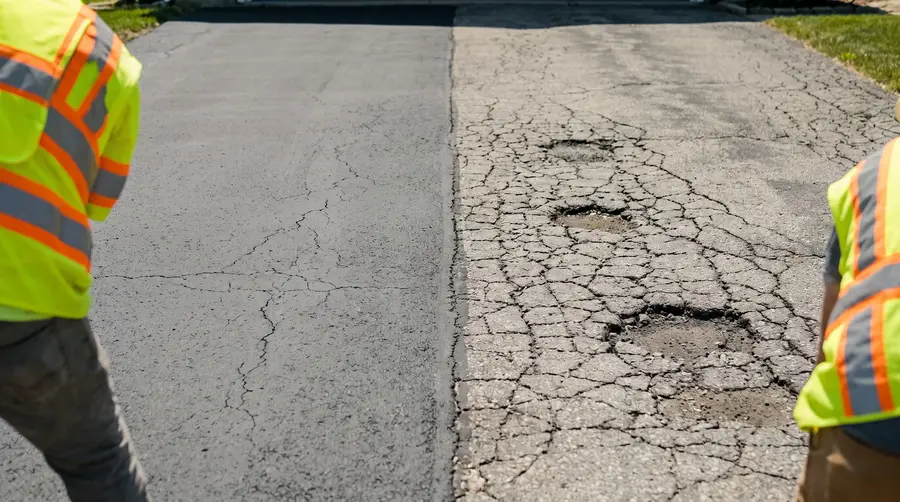
Alligator cracking is the one to take seriously. It means the base is moving under traffic, and no thickness of new asphalt on top will stop that. The third tab above turns this table into a quick check for your own pavement.
Can you pave over cracked asphalt?
Yes, but only some cracks. The size and pattern of the cracking decide whether you can pave over cracked asphalt or have to dig it out first. A new layer hides cracks for a while, but cracks in the old surface tend to work up through it, so each one should be treated before the overlay goes down.
| Type of crack | What to do before the overlay |
|---|---|
| Hairline cracks | Clean them out and seal them, or cover them with the tack coat and overlay |
| Cracks up to about 1 inch wide | Clean, then fill with a hot or cold crack filler |
| Wide or deep cracks | Clean, fill with sand or fine stone if deep, then top with filler or an asphalt patch |
| Alligator (web-like) cracking | Dig out the failed area, rebuild the base, and patch it with hot mix |
| Sunken or heaved areas | Remove and rebuild; an overlay will not fix them |
Swipe the table sideways to see all columns.
If you can fix every crack on this list, the overlay is worth doing. If most of the surface is alligator cracked, a new overlay is only a short-term cover, and the replacement figure in the next section is the better comparison.
Asphalt overlay vs replacement cost
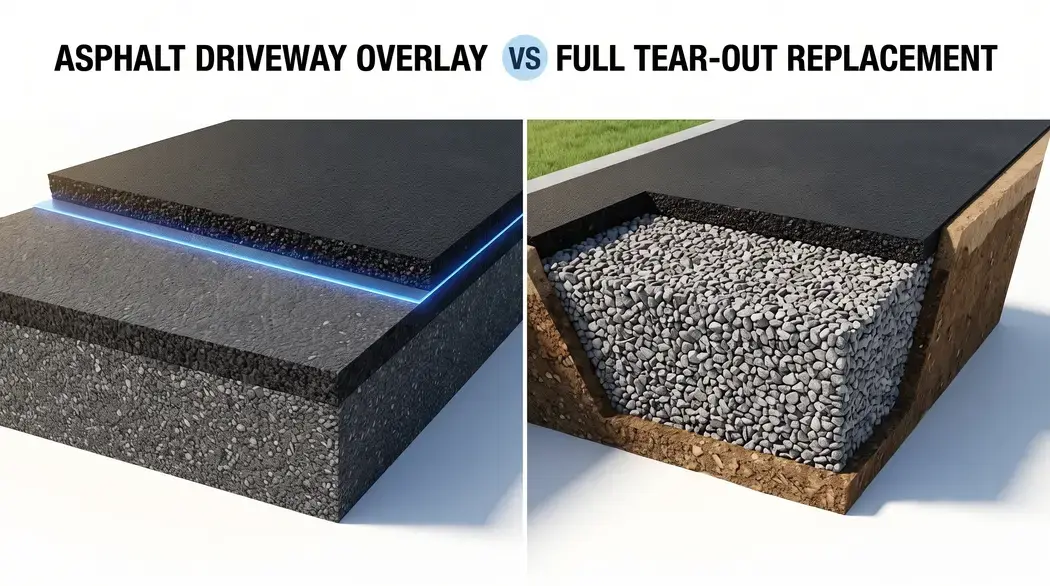
The asphalt overlay vs replacement cost question comes up on almost every asphalt on asphalt job. The real choice is usually between a new top layer and a full tear-out. The overlay costs less and takes a day, but it leaves the old base in place, and so it also leaves any weaknesses in that base.
| Feature | Overlay | Full replacement |
|---|---|---|
| Purpose | Restore the surface | Rebuild the whole structure |
| Typical cost | $1.75 to $3.50 per sq ft | $4 to $8 or more per sq ft |
| Added life | About 8 to 15 years | 20 to 30 years |
| Base work | Keeps the existing base | Replaces the stone base |
| Time on site | Usually 1 day | 2 to 4 days |
| Grade change | Raises the surface | Keeps the original height |
Swipe the table sideways to see all columns.
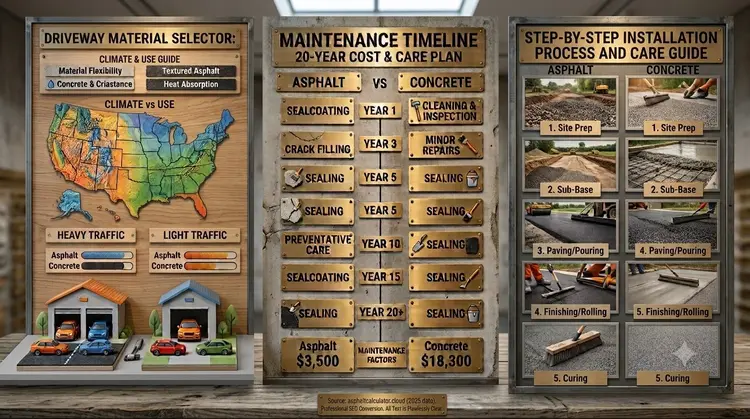
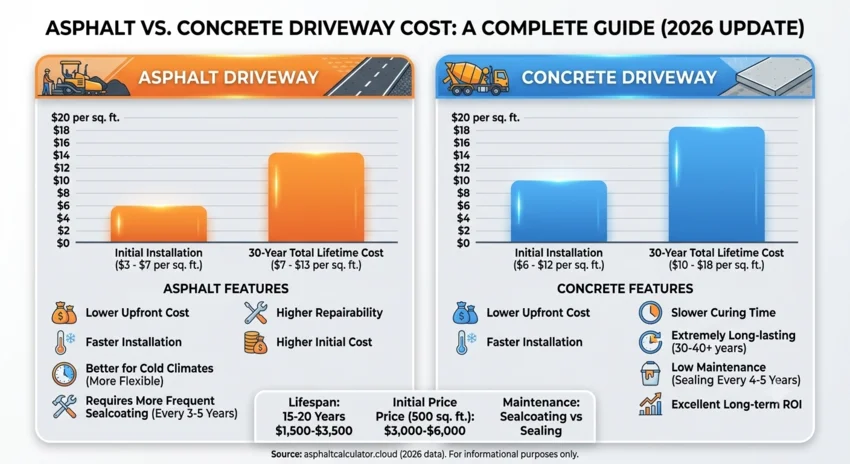
An overlay costs less because there is nothing to haul away and no new base stone. The compromise is reflective cracking, where cracks in the old layer slowly work up through the new one, and a higher surface that can leave a lip at garage doors, curbs, and sidewalks. The replacement figure includes removal, so it is above the $3 to $7 range quoted for a new driveway on bare ground. Our asphalt vs concrete cost guide compares lifespans in more detail.
How thick should an asphalt overlay be?
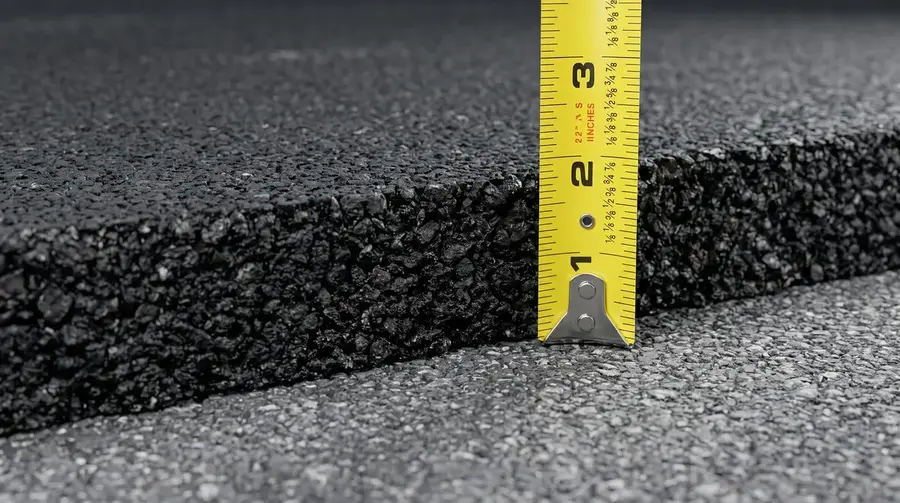
For the asphalt on asphalt calculator, thickness is the number that matters most. Asphalt on asphalt driveways are normally overlaid with 1.5 to 2 inches of compacted hot mix. Parking lots with delivery trucks usually need 2.5 to 3 inches. The layer cannot be too thin, because the stones in the mix need room to compact. A common rule is a thickness of at least two to three times the largest stone in the mix, which is why overlays much below 1.5 inches wear out fast.
Whatever you choose, the surface rises by the same amount. Two inches of overlay on a driveway leaves a 2 inch step at the garage door and may change how water drains toward the house. That is why contractors mill the edges, and why the height question is on the third tab. To see how the hot mix is placed and what to set on the paver, read the roller loss steps on our hot mix asphalt calculator.
How to put asphalt on asphalt: step by step
- Clean the surface. Sweep or blow off dirt, loose stone, and plants. Remove oil stains where the surface is soaked, since oil stops the bond.
- Repair first. Fill cracks, and dig out and patch holes and soft spots. Level any dips deeper than about an inch with patch mix or a leveling course.
- Mill the edges. Where the overlay meets a garage slab, curb, or gutter, the edge is often milled down 12 to 18 inches so the new layer sits flush instead of leaving a lip.
- Apply the asphalt tack coat. Spray a thin coat of asphalt emulsion over the entire surface so the new layer bonds to the old. Our bitumen calculator sizes the tack.
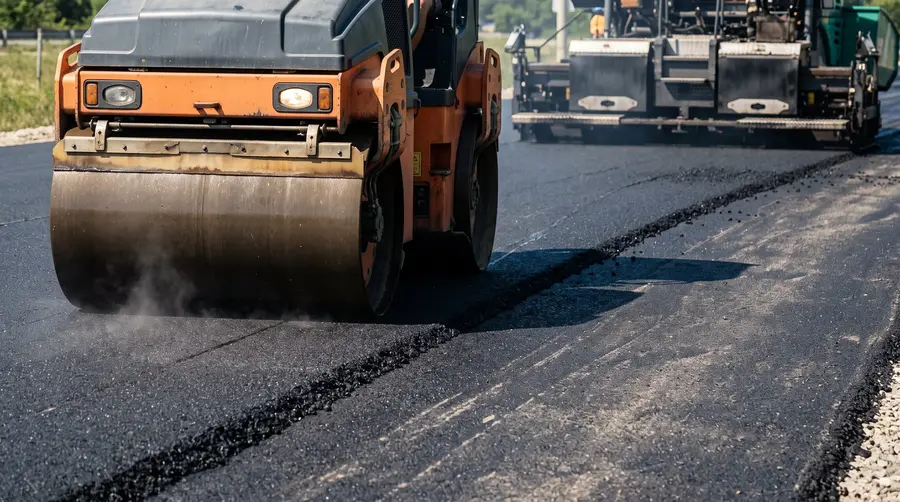
- Place and roll. Hot mix arrives from the plant at about 300°F to 325°F. It is spread by a paver and rolled while still hot, down to the finished 1.5 to 2 inches.
Asphalt patch before the overlay
Holes and soft spots need an asphalt patch before the overlay, not after it. For a shallow hole, clean it out and fill it with patch mix. For a deep one, dig out to firm ground, backfill with compacted stone, and patch with hot mix. Cold patch is a stopgap that suits small, shallow repairs, and hot mix bonds and lasts better. Compact every patch so it sits level with the surface, because a low patch becomes a dip in the new layer.
Asphalt tack coat rate
An asphalt tack coat is a thin spray of emulsion that glues the new layer to the old one. It is applied at about 0.05 to 0.10 gallons per square yard, which is roughly 4 to 8 gallons for a 700 sq ft driveway. The surface must be clean and dry, and the overlay should go down once the emulsion has turned from brown to black, or “broken”. Too much tack can make the layer slip, so use the rate and no more.
The formula for overlay tonnage
The asphalt on asphalt calculator uses the same weight calculation as any other paving layer. The only difference is that you use the overlay thickness and not the thickness of the whole pavement:
At the standard hot mix density of 145 lb/ft³ this simplifies to area × thickness × 0.00604. One cubic yard weighs about 1.96 tons, and a cubic yard holds 27 cubic feet. The table gives net tons before any buffer, so add 5 to 15% depending on how uneven the old surface is.
| Area | 1.5 in | 2 in | 2.5 in | 3 in |
|---|---|---|---|---|
| 500 sq ft | 4.53 tons | 6.04 tons | 7.55 tons | 9.06 tons |
| 1,000 sq ft | 9.06 tons | 12.08 tons | 15.10 tons | 18.12 tons |
| 2,000 sq ft | 18.12 tons | 24.17 tons | 30.21 tons | 36.25 tons |
| 5,000 sq ft | 45.31 tons | 60.42 tons | 75.52 tons | 90.62 tons |
Swipe the table sideways to see all columns.
For truck counts and conversions between tons and square yards, use the asphalt tonnage calculator. If a plant quotes a different density, check it with the asphalt density calculator.
Worked examples
Three typical asphalt on asphalt jobs, worked out by hand so you can check the asphalt on asphalt calculator.
Example 1: driveway overlay, 50 by 14 ft at 2 in
Area = 700 sq ft. Tons = 700 × 2 × 145 ÷ 24,000 = 8.46 tons. With a 10% buffer that is 9.30 tons, so order 10 tons, which fits on one tandem or tri-axle truck. At 2 inches, the surface rises 2 inches at the garage door.
Example 2: parking lot overlay, 100 by 60 ft at 2.5 in
Area = 6,000 sq ft. Tons = 6,000 × 2.5 × 145 ÷ 24,000 = 90.62 tons. The lot is fairly smooth, so use a 5% buffer: 95.16 tons, and order 96 tons. At about 16 tons per tri-axle that is 6 truck loads.
Example 3: what the overlay saves on a 1,000 sq ft driveway
An overlay at $1.75 to $3.50 per sq ft costs $1,750 to $3,500. Replacement at $4 to $8 per sq ft costs $4,000 to $8,000. Comparing the middle of each range, the overlay saves about $3,375, which is 56% less. Add a bad base and that saving disappears, because the overlay fails early.
Asphalt overlay cost per square foot
The asphalt overlay cost is usually quoted at $1.75 to $3.50 per square foot for materials and installation, so a 500 sq ft driveway runs about $875 to $1,750 and a 1,000 sq ft one about $1,750 to $3,500. These are planning numbers. The material alone, at $80 to $200 per ton and 2 inches thick, comes to roughly $0.97 to $2.42 per square foot, and the rest is labor, equipment, tack, and repairs.
The second tab of the asphalt on asphalt calculator compares the overlay and replacement price for your area. Surface repairs, the distance from the plant, and the price of oil and binder all move the total. For a full budget with labor and base work, use our asphalt driveway cost calculator.
Other ways to renew an old asphalt surface
- Crack sealing and sealcoat. If the pavement is sound and only faded, sealing the cracks and applying a sealcoat can add a few years for a fraction of the overlay price.
- Asphalt millings. Recycled asphalt from road milling projects can be spread and compacted for a low-cost rural driveway or farm road. Size the quantity with the crushed asphalt calculator.
- Tar and chip. Chip seal is a cheaper surface treatment over a sound base. See how it compares in the tar and chip cost calculator.
- Full depth reconstruction. When the base has failed, rebuilding the stone and surface together is the only lasting fix. The pavement calculator works out each layer.
Mistakes that shorten an overlay’s life
These are the usual reasons asphalt on asphalt jobs fail early:
- Overlaying a failing base. This is the most common reason overlays crack within a couple of years.
- Skipping the tack coat. Without it the layers can slide against each other and peel.
- Ignoring the height rise. Check garage doors, curbs, and drains before you decide on a thickness.
- Going too thin. Under 1.5 inches the mix is hard to compact, and it wears out fast.
- Paving over standing water. Regrade first, or the water will find its way under the new layer.
More paving calculators
For a quick square feet to tons figure on a new pavement, try our main free asphalt calculator square feet page.
Our main calculator: square feet to tons and cost in four steps.
Tons, truck loads, and square yard conversions.
Screed depth, lifts, and mix temperatures.
Installed driveway cost with base and labor.
Millings by the ton, yard, and area covered.
Asphalt, stone base, and subbase for a full section.
Binder weight, tack coat, and emulsion volume.
See how chip seal compares with hot mix.
Price, lifespan, and upkeep side by side.
Base stone and sand for patios and walkways.
Frequently asked questions
Can you lay asphalt on asphalt?
Yes, if the pavement underneath is sound. An overlay works over a firm base with only minor cracking. If the base is soft, or the surface has widespread alligator cracking, the new layer will fail the same way as the old one.Can you pave over cracked asphalt?
Fine, shallow cracks can be sealed and covered. Wide cracks should be filled first, and alligator cracking or sunken areas have to be dug out and rebuilt before any overlay goes down. Even sealed cracks can show through the new layer over time, which is called reflective cracking.How thick should an asphalt overlay be?
A residential driveway overlay is usually 1.5 to 2 inches compacted. Parking lots with delivery or truck traffic typically get 2.5 to 3 inches. Much below 1.5 inches is hard to compact and wears out quickly.How do you put asphalt on asphalt?
Clean the surface, repair cracks and holes, mill the edges where the overlay meets a slab or curb, spray an asphalt tack coat, then place and roll 1.5 to 2 inches of hot mix. Check that the pavement is sound first, since an overlay cannot fix a failed base.Can you lay 2 inches of asphalt over existing asphalt?
Yes. Two inches compacted is a common residential overlay, as long as the old pavement is structurally sound. It takes about 12 tons of hot mix per 1,000 square feet.How long does an asphalt overlay last?
Over a sound, well-bonded base an overlay often lasts 8 to 15 years. The result depends on the condition of the old pavement, how well the surface was prepared, and traffic.What is the asphalt overlay vs replacement cost difference?
A typical overlay costs about $1.75 to $3.50 per square foot installed. Tearing out and replacing the pavement runs about $4 to $8 per square foot or more, so an overlay often costs 40% to 50% less.Do I need an asphalt tack coat when paving over asphalt?
Yes. A thin tack coat of asphalt emulsion bonds the new layer to the old one. Without it the overlay can slide or peel. Typical rates are about 0.05 to 0.10 gallons per square yard.Can an asphalt patch be covered with an overlay?
Yes. Filling holes and low spots with an asphalt patch first gives the overlay an even base. Deep or large holes should be dug out, backfilled with stone, and patched with hot mix before the overlay.How many tons of asphalt do I need for an overlay?
Multiply the area in square feet by the overlay thickness in inches and by 0.00604. A 700 sq ft driveway at 2 inches needs about 8.46 tons, or about 9.3 tons with a 10% buffer. The asphalt on asphalt calculator above does this for you.Can you pour concrete on top of asphalt?
It is generally not a good idea for a driveway. Asphalt flexes and concrete does not, so the slab can crack and shift on an unprepared surface. Concrete over asphalt is done on some roads as an engineered process called whitetopping, and not as a quick fix.How long before you can drive on a new asphalt overlay?
Wait at least 24 to 48 hours before driving on it, and longer in hot weather. Avoid turning the steering wheel while the car is standing still for the first few weeks, since that can scuff the soft surface.Should I patch or overlay my asphalt driveway?
Patch when the damage is limited to a few small spots and the rest of the surface is in good shape. Overlay when the surface is worn or has many cracks but the base is sound. Replace when the base has failed. An asphalt patch is also the first step before most overlays.What is an asphalt tack coat?
An asphalt tack coat is a thin spray of asphalt emulsion applied between the old surface and the new layer so they bond. The usual rate is about 0.05 to 0.10 gallons per square yard, on a clean, dry surface.Summary
Laying asphalt on asphalt is the cheapest way to renew a driveway or lot whose base is still sound. Check for alligator cracking, soft spots, and drainage first, plan for the rise in height, and use a tack coat. Then work out the tons with the asphalt on asphalt calculator above and get at least two quotes before you commit.
Sources and resources
This page is for planning. Have a paving contractor check the base and the cracking before you order, and confirm tonnage and mix with your plant.