Hot Mix Asphalt Calculator: Formulas, Tonnage Estimates, and Specifications
A field-tested hot mix asphalt calculator for short tons, loose screed depth, and delivery costs — dialed in for residential driveways, commercial parking stalls, and road paving across the US.
Enter Your Project Details
Punch in your job site dimensions below. Fields marked * are required.
How to Use the Hot Mix Asphalt Calculator (Step-by-Step)
Running out of hot asphalt with forty feet of driveway left to pave is every paving crew’s nightmare. Putting your measurements through this hot mix asphalt calculator takes under two minutes and gives you the exact batch weight to order from the plant:
Measure the length and width of the prep area in feet. If you are paving an irregular driveway or parking pad, split the layout into rectangles, calculate each section, and sum the square footage.
Type in your desired final thickness in inches after roller compaction. For passenger cars and light pickups, 2.5 to 3 inches is standard. For commercial access, specify 4 to 6 inches.
Select your mix type. Most topcoats use standard dense surface mix averaging 145 lbs per cubic foot. Heavy stone base mixes run closer to 148 lbs per cubic foot due to larger aggregates.
Never order the bare minimum. Aggregates settle into low spots on the stone base, edges get raked out, and roller passes push material outward. A 10% contingency buffer keeps your crew safe.
The online hot mix asphalt calculator outputs net tons, buffered tons, and your loose screed depth—showing how thick your paver operator needs to pull the mat so it compacts down to the design thickness.
Why Accurate Hot Mix Asphalt Estimation Matters
Paving crews live and die by asphalt temperature. Hot mix asphalt leaves the batch plant between 300°F and 325°F. Once the dump truck backs into the paver hopper, the clock starts ticking. Once the asphalt cools past roughly 185°F, steel drums cannot pack the aggregates tightly, leaving open voids that absorb water and crack during winter freeze-thaw cycles.
If you order too little material, the paver screed runs empty mid-pull, creating an unsightly cold seam. If you order too much, you pay for asphalt tonnage that hardens in the truck bed and gets hauled back as waste. Using a dedicated hot mix asphalt calculator prevents cold seams and keeps your material budget on track.
How to Calculate Hot Mix Asphalt (The Math Behind It)
If you like checking the numbers on paper before placing the plant call, here is how paving estimators work out tonnage by hand. Compacted asphalt weighs right around 145 to 148 pounds per cubic foot (about 2.025 tons per cubic yard).
The 110-Pound Rule of Thumb
Experienced paving contractors use the 110-pound rule: one square yard of asphalt rolled down to 1 inch thick weighs almost exactly 110 pounds:
Multiply your square footage by your thickness in inches, multiply by 110, then divide by 2,000 to convert pounds into short tons.
The Cubic Foot Method
Converting Loose Screed Depth to Compacted Mat Depth
Asphalt loses roughly one-quarter of its thickness under vibratory rollers:
For 2.0 inches finished with a 20% roller squish: 2.0 ÷ (1 – 0.20) = 2.5 inches loose mix off the screed.
Hot Mix Asphalt Density Reference Table
| Mix Description | Compacted Weight | Coverage per Ton (at 2″ rolled) |
|---|---|---|
| Standard HMA Surface Wearing Mix | 145 lbs/cu ft | 8.9 Square Yards (~80 sq ft) |
| Dense-Graded Binder / Base Mix | 148 lbs/cu ft | 8.7 Square Yards (~78 sq ft) |
| High-Density Heavy-Duty Mix | 150 lbs/cu ft | 8.6 Square Yards (~77 sq ft) |
| Warm Mix Asphalt (WMA) | 143–145 lbs/cu ft | 9.0 Square Yards (~81 sq ft) |
Step-by-Step Practical Calculation Examples
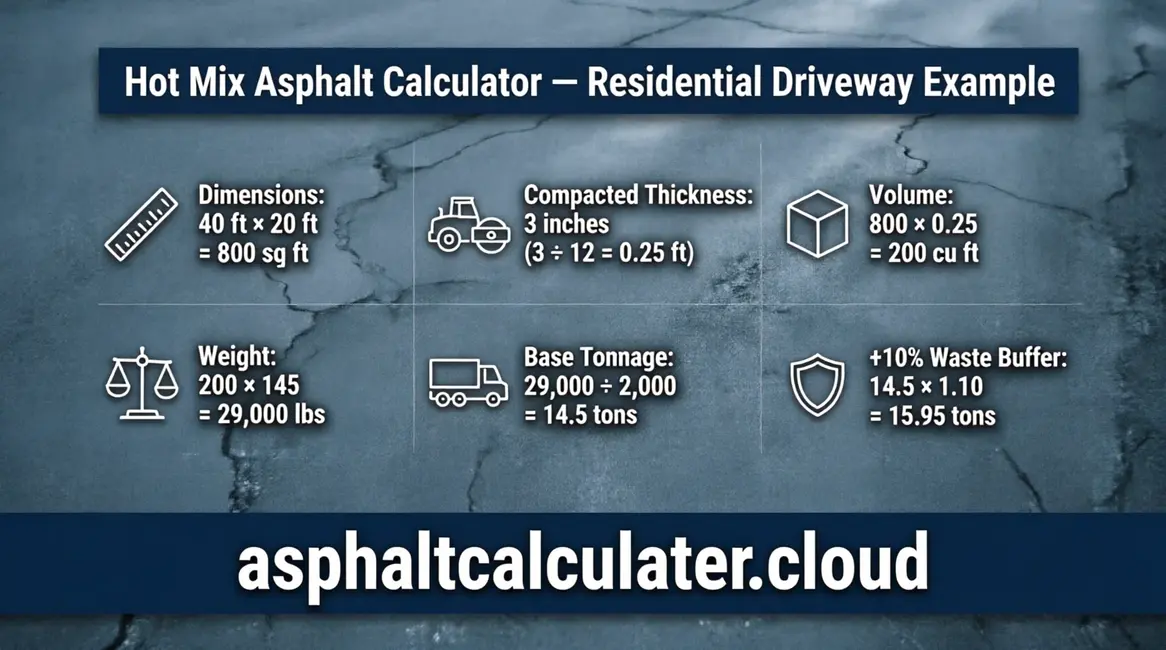
Example 1: Residential Driveway (Square Feet to Tons)
A homeowner wants to pave an 800 sq ft driveway with a 3-inch compacted surface layer.
- Dimensions: 40 ft long × 20 ft wide (800 sq ft)
- Thickness: 3 inches (3 ÷ 12 = 0.25 ft)
- Volume: 800 × 0.25 = 200 cu ft
- Weight: 200 × 145 lbs = 29,000 lbs
- Base Tonnage: 29,000 ÷ 2,000 = 14.5 short tons
- 10% Safety Buffer: 14.5 × 1.10 = 15.95 tons (Order: 16 Tons)
Plugging these figures into a hot mix asphalt calculator square feet estimator gives you 16 tons—perfect for one full tandem dump truck.
Example 2: Commercial Parking Pad Tonnage
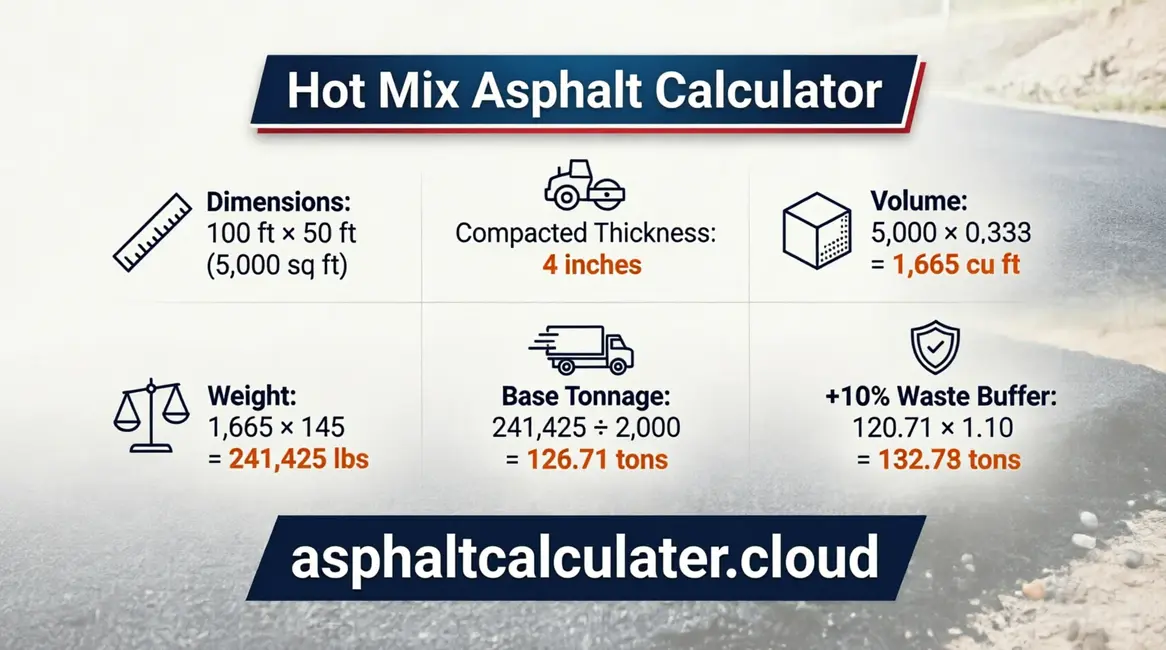
A local warehouse is paving a 5,000 sq ft pad for delivery vans, designed at 4 inches compacted thickness.
- Dimensions: 100 ft long × 50 ft wide (5,000 sq ft)
- Thickness: 4 inches (4 ÷ 12 = 0.333 ft)
- Volume: 5,000 × 0.333 = 1,665 cu ft
- Weight: 1,665 × 145 lbs = 241,425 lbs
- Base Tonnage: 241,425 ÷ 2,000 = 120.71 tons
- 10% Safety Buffer: 120.71 × 1.10 = 132.78 tons (Order: 133 Tons)
Putting this through a hot mix asphalt calculator tons tool shows you need 133 tons. At 19 to 20 tons per tri-axle truck, you will schedule 7 truck rotations.
What Is in Hot Mix Asphalt?
When looking at what is in hot mix asphalt, also formally classified as asphalt concrete, it breaks down into three key ingredients:
- Crushed Mineral Rock (90% to 95% by weight): Coarse angular stone (crushed granite or limestone), manufactured sand, and fine rock dust. The rough edges lock together under the roller to handle vehicle loads.
- Liquid Asphalt Bitumen (4% to 8% by weight): The sticky black petroleum cement that glues the stone matrix together and seals out water. To calculate binder weights separately, check our bitumen calculator.
- Compacted Air Voids (3% to 5% by volume): Essential breathing room inside the mat to prevent bleeding and surface flushing under high summer heat.
How Is Hot Mix Asphalt Made?
Understanding how is hot mix asphalt made explains why your crew cannot afford delays:
- Drying the Rock: Crushed stone moves into a rotary drum dryer to remove all internal moisture.
- Heating Aggregates: Stone is heated to 300°F to 350°F so liquid binder can bond tightly to the rock.
- Injecting Hot Binder: Liquid asphalt cement at 300°F is injected and churned until every rock particle is coated with bitumen.
- Silo Drop and Trucking: The steaming mix drops into insulated trucks at 320°F and gets tarped tight for highway transport.
- Laying and Rolling: The mix dumps into the paver hopper and must be rolled between 275°F and 300°F before it cools below 175°F.
Types of Hot Mix Asphalt and Applications
The standard types of hot mix asphalt include:
- Dense-Graded HMA: The standard impermeable mix for driveways, parking lots, and city streets.
- Open-Graded Friction Course (OGFC): Coarse stone structure that drains rainwater through the surface to reduce hydroplaning.
- Stone Matrix Asphalt (SMA): Heavy stone-on-stone skeleton bound by polymer-modified bitumen to resist rutting under semi-truck loads. Checking your mix with our hot mix asphalt calculator helps determine precise tonnage across all these mix profiles.
State DOT Hot Mix Asphalt Specifications
Standard hot mix asphalt specifications enforce:
- In-Place Mat Density: Compaction must reach 92% to 97% of theoretical maximum specific gravity.
- Gradation Bands: Strict sieve tolerances ensure uniform aggregate distribution without segregation.
- Tack Coat Application: Applying an SS-1h tack coat at 0.05 to 0.10 gal/sq yd is mandatory over existing pavement.
Plant mix designs—like those from a pike hot mix asphalt calculator or regional plants—may use 112 to 115 lbs/sq yd/in based on local aggregate weights. Always verify your plant ticket before paving.
Asphalt Tonnage Quick Reference Chart
Standard asphalt orders across common project sizes, including a 10% buffer:
| Project Size | 2-Inch Compacted Mat | 3-Inch Compacted Mat | 4-Inch Compacted Mat |
|---|---|---|---|
| 500 sq ft | 3.0 Tons | 4.3 Tons | 5.8 Tons |
| 1,000 sq ft | 5.8 Tons | 8.7 Tons | 11.6 Tons |
| 2,000 sq ft | 11.6 Tons | 17.3 Tons | 23.1 Tons |
| 5,000 sq ft | 28.9 Tons | 43.3 Tons | 57.8 Tons |
| 10,000 sq ft | 57.8 Tons | 86.6 Tons | 115.5 Tons |
Contractor Tips for Ordering Hot Mix Asphalt
- Order 10% more than mathematical volume to cover uneven subgrades and edge roll.
- Schedule trucks so loads arrive hot without idling in traffic.
- Verify the paver screed is set to loose depth, not compacted depth.
- Once you run calculations through the hot mix asphalt calculator, use our asphalt driveway cost calculator for installed project pricing.
- Compare options with our tar and chip driveway cost calculator before ordering material.
Frequently Asked Questions (FAQs)
How to figure hot mix asphalt needed for a job?
Multiply square footage by depth in feet, multiply by 145 lbs/cu ft, divide by 2,000 for short tons, and add 10%. Our free hot mix asphalt calculator solves this in seconds.
How thick should hot mix asphalt be installed?
Residential driveways require 2.5 to 3 inches compacted. Commercial parking lots need 4 to 6 inches in two lifts.
How much is 1 ton of hot asphalt?
FOB plant price is $80 to $115 per ton. Installed turnkey cost ranges from $140 to $240 per ton.
What is the average hot mix asphalt price per ton?
Standard dense surface mix averages $85 to $110 per ton at the batch plant.
Can Hot Mix Asphalt be laid over existing asphalt or concrete?
Yes, if the base is stable. Fill cracks and apply tack coat at 0.05 to 0.10 gal/sq yd. See our asphalt vs concrete driveway cost guide.
How much does a cubic yard of hot mix asphalt weigh?
Compacted hot mix asphalt weighs approximately 4,050 pounds (2.025 short tons).
Related Paving Calculators
- Asphalt Calculator — main hub for all paving calculators.
- Asphalt Driveway Cost Calculator — estimate installed driveway paving costs.
- Tar and Chip Driveway Cost Calculator — evaluate rural chip-seal costs.
- Bitumen Calculator — calculate binder and emulsion quantities.
- Asphalt vs Concrete Driveway Cost — compare surface pricing and lifespan.
This estimator is for planning purposes. Verify final tonnage and mix specs with your local plant.
Hot Mix Asphalt Calculator
Free Hot Mix Asphalt Calculator to estimate exact tonnage, volume, tack coat, and truckloads for driveways and paving. Instant regional US price estimates.
Price Currency: USD
Operating System: Web Browser (Windows, macOS, iOS, Android)
Application Category: Business Application