Free Paver Base Calculator: Square Feet to Cubic Yards and Tons
Enter the size of your patio, walkway, or driveway and this paver base calculator tells you how much crushed stone, bedding sand, and how many pavers to order. You get cubic yards and tons for the stone and sand, plus a paver count with waste built in. It works in feet and inches or in meters and centimeters, so you can use it as a paver base calculator square feet tool or a metric one.
- 100% free, no sign-up
- Stone, sand, and pavers
- Yards, tons, and cubic meters
- Imperial and metric
Last updated: October 27, 2026
How much base stone does the project need?
How much bedding sand does the project need?
How many pavers do you need?
How to use the paver base calculator
Most patios go wrong underneath, where nobody sees it. A few minutes with the numbers gets the stone, sand, and pavers ordered correctly the first time. For a larger layered job with asphalt on top, our asphalt calculator may suit you better:
- Pick the calculator mode. Use the tabs to choose Base Stone, Bedding Sand, or Paver Count. Each one works out a different order, so run all three for a full patio or walkway.
- Measure the area and choose a depth. Enter the length and width of the paved area. Choose a project type to fill in a typical base depth, or type your own. Use the units switch if you measure in meters and centimeters.
- Allow for the base overhang. Most installers build the stone base a little wider than the pavers so the edges are supported. Pick 6 or 12 inches per side if that is your plan, or leave it at none.
- Set the buffer. A 10% buffer is a safe default. Choose 15% on soft ground where stone sinks into the soil, and 5% on a firm, level site.
- Read the order. Press Calculate to see the volume and weight to order. Quarries sell stone and sand by the ton or the yard, so you get both.
What goes under a paver patio
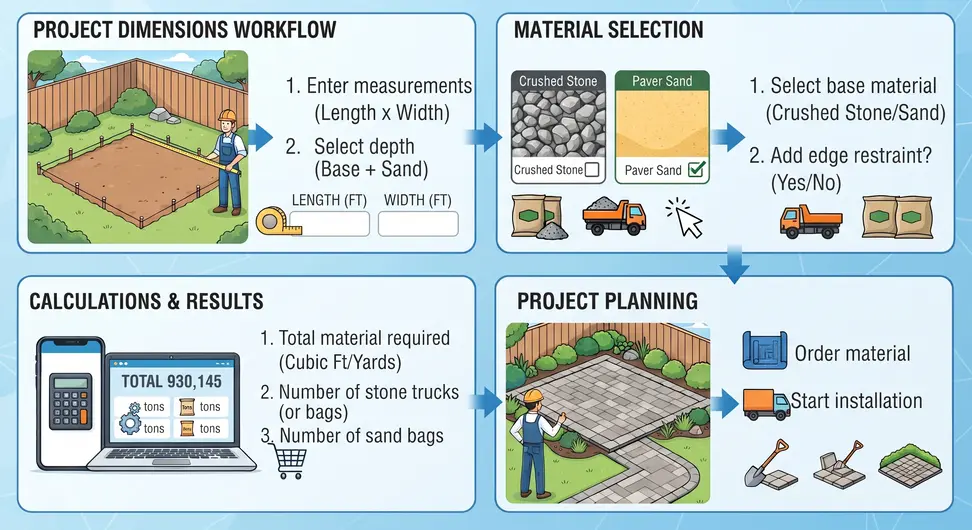
A paver surface is a system, not a single layer. The stone base carries the load, the thin sand layer lets each paver sit level, and the edge restraint keeps everything from creeping sideways. Skimp on the base and the surface will dip within a couple of seasons, however good the pavers are. Each layer is ordered separately, which is why this paver base calculator has a tab for each material.
| Layer | Purpose | Usual depth |
|---|---|---|
| Compacted subgrade | Firm soil that does not move | Not bought |
| Crushed stone base | Spreads the load and drains water | 4 to 8 in |
| Bedding sand | Gives each paver an even bed | About 1 in |
| Pavers | The wearing surface | 2.4 in (6 cm) for foot traffic, 3.1 in (8 cm) for cars |
| Joint sand | Locks the pavers together | Swept into the joints |
Swipe the table sideways to see all columns.
To work out how deep to dig, add the base, the sand, and the paver thickness. A walkway with a 4 inch base, 1 inch of sand, and a 2.4 inch paver needs a cut of about 7.4 inches below finished grade.
How deep should the base be?
There is no single answer, because the soil and the traffic decide it. These ranges are a starting point. They are what the project type menu fills in, and a local installer or your paver supplier can confirm them for your area.
| Project | Firm ground | Soft clay or wet soil |
|---|---|---|
| Walkway | 4 in | 6 in |
| Patio | 4 to 6 in | 6 to 8 in |
| Driveway with cars | 6 to 8 in | 8 to 12 in |
Swipe the table sideways to see all columns.
Base stone is spread and compacted in lifts of about 4 inches, so a thick base is built in two passes. A plate compactor should go over each lift. If a driveway will have asphalt on top instead of pavers, the layers change, and our pavement calculator handles the asphalt, base, and subbase together.
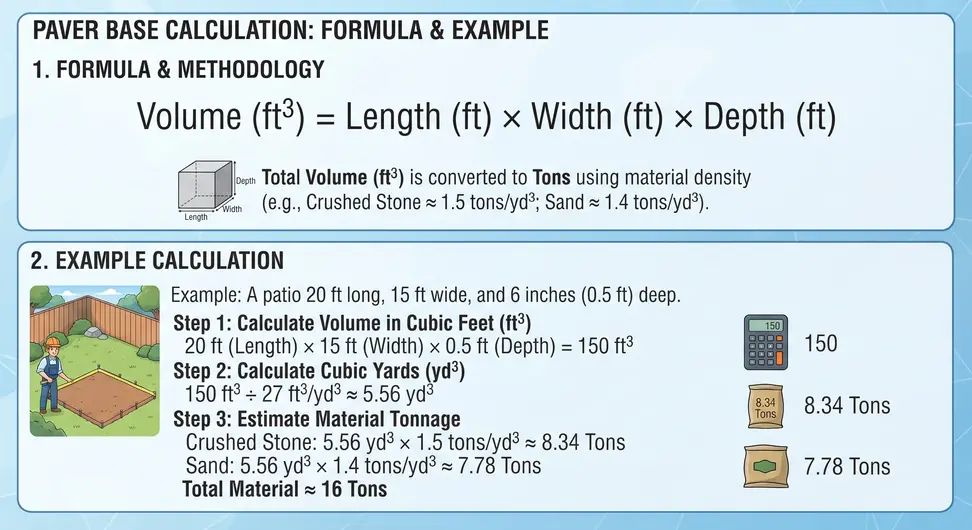
The math behind the paver base calculator
Behind the paver base calculator, the steps are the same for stone and for sand. Only the depth and the weight change:
If the base is built wider than the pavers, add twice the overhang to both the length and the width before you multiply. A 12 inch overhang on a 20 by 15 foot patio makes the base 22 by 17 feet, which is 374 sq ft instead of 300. That one choice adds about 25% to the stone, so it is worth deciding before you order.
Quick reference: stone volume and weight
If you already know your area, look up the volume here, then confirm it with the paver base calculator above. Weights are for compacted crushed stone at 135 lb/ft³, before any buffer.
| Area | Depth | Cubic feet | Cubic yards | Tons |
|---|---|---|---|---|
| 100 sq ft | 4 in | 33.3 cu ft | 1.23 cu yd | 2.25 tons |
| 100 sq ft | 6 in | 50.0 cu ft | 1.85 cu yd | 3.38 tons |
| 200 sq ft | 4 in | 66.7 cu ft | 2.47 cu yd | 4.50 tons |
| 200 sq ft | 6 in | 100.0 cu ft | 3.70 cu yd | 6.75 tons |
| 300 sq ft | 6 in | 150.0 cu ft | 5.56 cu yd | 10.12 tons |
| 500 sq ft | 6 in | 250.0 cu ft | 9.26 cu yd | 16.88 tons |
| 500 sq ft | 8 in | 333.3 cu ft | 12.35 cu yd | 22.50 tons |
Swipe the table sideways to see all columns.
Worked examples
Here is how the paver base calculator handles a small patio, a backyard patio, and a driveway. You can check every figure by hand.
Example 1: small patio, 10 by 10 ft with a 4 in base
Area = 100 sq ft. Volume = 100 × 4 ÷ 12 = 33.3 cu ft, or 1.23 cu yd. That weighs about 2.25 tons at 135 lb/ft³. With a 10% buffer, order 1.50 cu yd of stone.
Example 2: backyard patio, 20 by 15 ft with a 6 in base, 1 in of sand, 20×20 pavers
Area = 300 sq ft. Stone: 300 × 6 ÷ 12 = 150 cu ft, or 5.56 cu yd and 10.12 tons. With 10% extra, order about 6.25 cu yd or 11.1 tons. Sand: 300 × 1 ÷ 12 = 25 cu ft, or 0.93 cu yd, about 1.25 tons. Order 1.25 cu yd with a buffer. Pavers: 20×20 inch pavers cover 2.78 sq ft, so 300 ÷ 2.78 = 108 pavers, and 119 with a 10% allowance.
Example 3: driveway, 12 by 40 ft with an 8 in base
Area = 480 sq ft. Volume = 480 × 8 ÷ 12 = 320 cu ft, or 11.85 cu yd, which weighs 21.6 tons. With a 10% buffer that is 23.8 tons, so order about 13.25 cu yd. At roughly 16 tons per tri-axle, that is two truck loads. Stone this thick goes down in two compacted lifts of 4 inches.
Stone and sand are not the same order
Never treat base rock and bedding sand as one material in the paver base calculator, or at the quarry. The stone is angular, compacts hard, and drains. The sand is a thin leveling bed and should be coarse concrete sand, not fine play sand, which holds water and shifts. Do not use sand to fix dips in the base. Fix the base first, then screed the sand to an even depth.
| Material | Weight | Tons per cu yd |
|---|---|---|
| Crushed stone base, compacted | 135 lb/ft³ | 1.82 tons |
| Bedding sand, coarse | 100 lb/ft³ | 1.35 tons |
Swipe the table sideways to see all columns.
Some installers replace part of the base on a driveway with recycled asphalt millings. If you go that way, the crushed asphalt calculator sizes the millings, which weigh less than stone. For the real weight of any mix, check it against our asphalt density calculator.
How many pavers per 100 square feet
Pavers are counted, not weighed, so the size is what matters. The paver count tab of the paver base calculator does this for any size, and this table is a quick check. Numbers are before waste.
| Paver size | Coverage each | Per sq ft | Per 100 sq ft |
|---|---|---|---|
| 4 x 8 in brick | 0.222 sq ft | 4.50 | 450 |
| 6 x 6 in | 0.250 sq ft | 4.00 | 400 |
| 12 x 12 in | 1.000 sq ft | 1.00 | 100 |
| 16 x 16 in | 1.778 sq ft | 0.56 | 57 |
| 20 x 20 in | 2.778 sq ft | 0.36 | 36 |
| 24 x 24 in | 4.000 sq ft | 0.25 | 25 |
Swipe the table sideways to see all columns.
Mistakes that leave a patio short
Most short orders trace back to the inputs, not the paver base calculator. Watch for these:
- Measuring only the pavers. The base is often wider than the surface, so add the overhang before you order stone.
- Ordering loose volume. Stone is delivered loose and compacted down, so the buffer matters more than it does for sand.
- Mixing up tons and yards. Quarries quote one or the other. Use the weight line if the price is per ton.
- Skipping compaction between lifts. A thick base laid in one pass settles unevenly under the pavers.
- Forgetting the edge restraint. It is not in these totals, so budget for it separately.
More paving calculators
This paver base calculator stops at the patio edge. If your project is bigger than a patio, or has asphalt in it, these cover the rest. Our main free asphalt calculator square feet page is the best place to start for tons and cost.
Our main calculator: square feet to tons and cost in four steps.
Asphalt, stone base, and subbase for a full section.
Tons, truck loads, and square yard conversions.
Millings by the ton, yard, and area covered.
Screed depth, lifts, and mix temperatures.
kg/m³, lb/ft³, and core density tests.
Binder weight, tack coat, and emulsion volume.
See how chip seal compares with other driveways.
Frequently asked questions
How many 20×20 pavers do I need?
A 20×20 inch paver covers about 2.78 square feet. Divide your project area by 2.78 and add 5 to 10% for cuts. For a 300 sq ft patio that is 108 pavers before waste, or about 119 with a 10% allowance.How many 24×24 pavers for 100 square feet?
A 24×24 inch paver covers exactly 4 square feet, so 100 sq ft needs 25 pavers before waste. With cuts, plan on 27 or 28.How many pavers are in 1 square meter?
It depends on the size. A standard 10×20 cm brick covers 0.02 square meters, so one square meter takes 50 of them. A 30×30 cm paver covers 0.09 square meters, which is about 11.How do I calculate how many pavers I need?
Multiply the length by the width to get the area. Multiply the paver length by its width in inches and divide by 144 to get its coverage in square feet. Divide the area by that coverage and add 5 to 10% for waste.Is it cheaper to pour a concrete patio or use pavers?
A plain poured slab is usually cheaper at the start, because the labor is lower. Pavers tend to cost more up front but handle freeze and thaw better, can be lifted and re-laid when a section settles, and are repaired without a visible patch.How much crushed stone do I need for 100 square feet?
At a 4 inch depth, 100 sq ft needs 33.3 cubic feet, which is 1.23 cubic yards or about 2.2 tons at 135 lb/ft³. At 6 inches it is 1.85 cubic yards, or about 3.4 tons. Add 10% to either.How do I convert my measurements into cubic yards?
Multiply the length by the width in feet, then by the depth in feet (inches divided by 12), and divide the result by 27. Or multiply the square feet by the depth in inches and divide by 324.Do driveways need a thicker base than patios?
Yes. A walkway or patio is usually fine with 4 to 6 inches of compacted stone. A driveway that carries cars needs about 6 to 8 inches, and more on clay or soft ground. A layered section with asphalt on top is better checked in our pavement calculator.How much extra material should I order?
Order about 10% extra stone and sand, and 5 to 10% extra pavers. Stone settles into the ground below it, sand is lost at the edges, and pavers get cut at the borders.Sources and resources
These are planning estimates. Soil, drainage, and local codes change the depths you need, so confirm quantities with your quarry or supplier before you order.
Paving Base Calculator: Stone, Sand & Pavers in Seconds
Enter your patio, walkway or driveway size and instantly get the crushed stone, bedding sand and pavers you need. Free paving base calculator.
Price Currency: USD
Operating System: All
Application Category: Utility Application