Bitumen Calculator: Quantity, Percentage and Density
This bitumen calculator works out how much binder a road, driveway or spray coat needs. Enter the size of the layer and the mix, and it returns bitumen in US tons, metric tonnes, pounds and gallons. It also converts binder percentage, blends two grades and converts weight to volume at any temperature.
- 100% free, no sign-up
- US and metric units
- 5 calculators in one
- Formulas and examples
Last updated: October 28, 2026
How much bitumen does the layer need?
What percent of the mix is bitumen?
How much bitumen does a spray coat use?
How much of each grade makes the blend?
What does that bitumen weigh, and what volume is it?
How to use the bitumen calculator
Work through the tabs of the bitumen calculator in whichever order suits the job. For the tons of finished asphalt a layer needs, our asphalt calculator gives the mix weight, and this page then tells you how much of that weight is bitumen.
- Pick the tab you need. The five tabs cover road quantity, binder percentage, spray rate, blend ratio and weight to volume conversion. Start with Road Quantity if you are pricing a paving job.
- Enter your measurements. Type the length, width and compacted thickness of the layer, or the area and spray rate for a coat. Choose US units or metric on the first tab.
- Choose the mix and binder content. Pick a mix density, or enter a tested one, then add the binder percent from your mix design. Most road mixes sit between 4% and 6% by weight of the mix.
- Read and copy the result. Press Calculate to see bitumen in US tons, metric tonnes, pounds and gallons. Use Print or Export to keep a copy for your estimate.
The tab 1 result is the one most estimators need. It turns an area and a depth into a bitumen order in tons, plus a cost if you add a price.
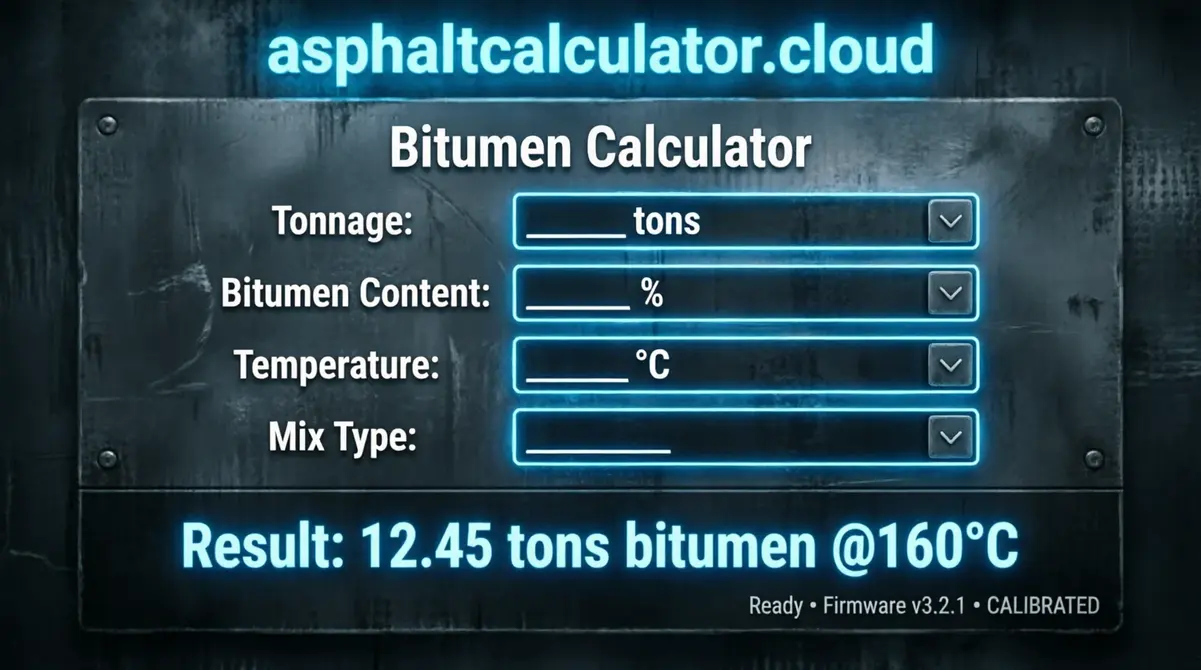
How much bitumen is in asphalt?
Asphalt pavement is mostly crushed stone. Bitumen is the black glue that holds the stone together, and it makes up only about 4% to 6% of the mix by weight. A ton of finished hot mix therefore carries about 80 to 120 pounds of bitumen and the rest is stone and sand.
A bitumen calculator starts from that small share, and it still matters. Too little binder and the surface ravels and cracks. Too much and it bleeds, ruts and turns slick in summer. Mix designers set the exact percentage in the lab, and your job is to turn that percentage into a purchase quantity.
How to calculate bitumen percentage
In any bitumen calculator, content is quoted on one of two bases, and mixing them up is the most common mistake we see. The Binder % tab of the bitumen calculator handles both.
Road specifications use percent by total mix. Some laboratory reports use percent by aggregate, which is always a little higher. To move from one to the other, use this conversion:
| By total mix | By dry aggregate | Bitumen per 100 lb of mix |
|---|---|---|
| 4.0% | 4.17% | 4.0 lb |
| 4.5% | 4.71% | 4.5 lb |
| 5.0% | 5.26% | 5.0 lb |
| 5.5% | 5.82% | 5.5 lb |
| 6.0% | 6.38% | 6.0 lb |
| 6.5% | 6.95% | 6.5 lb |
Swipe sideways to see every column.
Example
A lab sample has 5.0 lb of bitumen and 95.0 lb of dry aggregate. By total mix, 5 ÷ 100 × 100 = 5.00%. By aggregate, 5 ÷ 95 × 100 = 5.26%. Same sample, two different numbers, so always check which basis the specification uses.
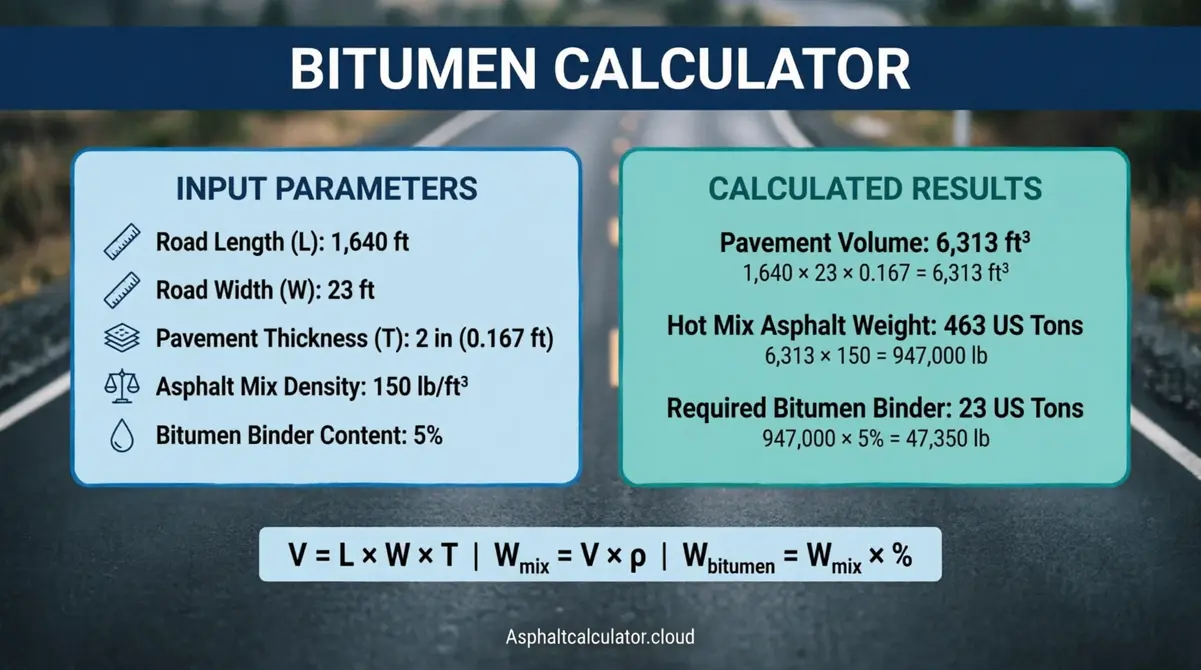
Bitumen calculator formula for a road
The bitumen calculator runs three steps to turn a layer size into a bitumen order. Use the compacted thickness of the finished layer, not the loose depth behind the paver.
In metric, volume is length × width × thickness in meters, mix weight is volume × density in kg/m³, and bitumen is mix weight × binder percent ÷ 100.
US example: a 1,000 ft county road
Layer: 1,000 ft long, 24 ft wide, 2 in thick. Mix density 145 lb/ft³. Binder 5%.
- Volume: 1,000 × 24 × 2 ÷ 12 = 4,000 cu ft
- Mix weight: 4,000 × 145 = 580,000 lb = 290 US tons
- Bitumen: 580,000 × 5% = 29,000 lb = 14.5 US tons (13.15 metric tonnes)
Metric example: a 500 m road
Layer: 500 m long, 7 m wide, 50 mm thick. Mix density 2,400 kg/m³. Binder 5%.
- Volume: 500 × 7 × 0.05 = 175 m³ (6,180 cu ft)
- Mix weight: 175 × 2,400 = 420,000 kg = 420 tonnes (463 US tons)
- Bitumen: 420,000 × 5% = 21,000 kg = 21 tonnes (23.15 US tons)
If you buy in drums, 21 tonnes is about 105 drums of 200 kg each. A standard road tanker carries around 25 tonnes, so this job fits in one delivery.
Typical binder content by pavement layer
Different layers of a road use different stone sizes and different amounts of bitumen. Smaller stone has more surface to coat, so wearing courses use more binder than a base. Use these ranges as a sanity check against your mix design and against what the bitumen calculator returns.
| Layer | Job of the layer | Stone size | Binder by mix | Compacted density |
|---|---|---|---|---|
| Wearing course | Grip and waterproofing | 10 to 14 mm | 5.0% to 6.0% | 2,380 to 2,420 kg/m³ |
| Binder course (DBM) | Spreads load, resists fatigue | 20 to 28 mm | 4.0% to 5.0% | 2,400 to 2,450 kg/m³ |
| Dense bituminous base | Structural foundation | 32 to 40 mm | 3.5% to 4.5% | 2,350 to 2,400 kg/m³ |
| Stone mastic asphalt (SMA) | Rut resistance on heavy roads | 10 to 14 mm | 6.0% to 7.0% | 2,320 to 2,380 kg/m³ |
Swipe sideways to see every column.
For the compaction side of the same mix, see our asphalt density calculator. For layer depth and screed settings, the hot mix asphalt calculator goes deeper.
Bitumen density and temperature
Weight and volume are not the same thing for bitumen. The weight never changes, but the volume grows as the bitumen heats up. That is why refineries and suppliers correct every delivery back to 15°C (59°F) before invoicing.
At 15°C, bitumen weighs about 1,020 kg/m³ (63.7 lb/ft³). Grades vary a little, from about 1,010 to 1,050 kg/m³. By the time it reaches mixing temperature, density has fallen to about 930 kg/m³.
| Temperature | Density (kg/m³) | Density (lb/ft³) | Where you meet it |
|---|---|---|---|
| 59°F (15°C) | 1,020 | 63.7 | Billing baseline |
| 77°F (25°C) | 1,014 | 63.3 | Penetration test temperature |
| 140°F (60°C) | 991 | 61.9 | Viscosity testing |
| 212°F (100°C) | 966 | 60.3 | Pumping threshold |
| 275°F (135°C) | 945 | 59.0 | Kinematic viscosity test |
| 320°F (160°C) | 930 | 58.1 | Plant mixing |
Swipe sideways to see every column.
One metric tonne of bitumen fills about 980 liters (259 US gallons) at 15°C. One US ton fills about 889 liters (235 US gallons). The Convert tab in the bitumen calculator shows the volume at any of the temperatures above.
Spray rates for prime, tack and chip seal
Spray coats are measured by how much bitumen ends up on each square foot or square meter. The rates below are bitumen left on the surface after an emulsion has broken, which is how most specifications state them.
| Coat | Purpose | kg per m² | lb per sq ft |
|---|---|---|---|
| Prime coat | Seals a stone base before paving | 0.6 to 1.2 | 0.12 to 0.25 |
| Tack coat | Bonds a new layer to an old one | 0.2 to 0.5 | 0.04 to 0.10 |
| Chip seal | Wearing surface under rolled stone | 1.2 to 2.0 | 0.25 to 0.41 |
| Bitumen paint | Damp-proofing on concrete and masonry | 0.35 to 0.55 | 0.07 to 0.11 |
Swipe sideways to see every column.
Example
A 5,000 sq ft parking lot gets a tack coat at the middle rate of 0.35 kg/m², which is 0.072 lb per sq ft. That is 5,000 × 0.072 = about 360 lb of bitumen. If the emulsion is 65% bitumen, order about 554 lb of emulsion.
Paint coverage follows the same rate. At 0.35 to 0.55 kg/m², a liter covers about 2 to 3 m² per coat, so two coats on 100 m² of wall take roughly 70 to 105 liters. Add about 10% for rough masonry.
Tar calculator: is tar the same as bitumen?
If you searched for a tar calculator, you are in the right place. On a driveway or road, “tar” almost always means bitumen. The two words are used loosely, and contractors still talk about “tar and chip” when they mean a bitumen emulsion with stone rolled into it.
Strictly, they are different materials. Bitumen comes from crude oil and is the binder in modern asphalt. Tar is made from coal or wood and was common on older roads and in some driveway sealers. Coal tar sealers are now restricted in several US states and cities because of their chemical content, so check local rules before you buy a product sold as tar.
How to calculate tar is the same job as any spray coat. Take the area, choose the rate for the treatment, and multiply. The Spray Rate tab of the bitumen calculator does that and also converts to emulsion if you give it the residue percent. For stone and total price on a chip seal driveway, use our tar and chip driveway cost calculator.
Blending two grades of bitumen
Sometimes a plant needs a grade it does not have in a tank, so it blends a hard grade with a soft one. Penetration blends on a logarithmic scale, which means a straight average gives the wrong answer.
Example
To reach a penetration of 80 from grade 60 and grade 100, the share of the harder grade is (log 80 − log 100) ÷ (log 60 − log 100) = 43.7%, and the softer grade makes up the other 56.3%. For a 25 tonne batch that is 10.92 tonnes of the 60 grade and 14.08 tonnes of the 100 grade.
Real grades are ranges, so use the midpoint, for example 65 for a 60/70 grade. A blend is only a starting point until a lab test confirms it.
Bitumen tank volume
Bulk bitumen sits in heated tanks at asphalt plants. Dip the tank to find the liquid height, work out the volume, then multiply by the density at the stored temperature.
Example
A horizontal tank 2.5 m across and 8 m long holds π × 1.25² × 8 = 39.27 m³. At 15°C that is about 40.06 tonnes of bitumen. Heated to 160°C, the same volume holds about 36.52 tonnes, because the bitumen is less dense.
Common bitumen calculation mistakes
- Mixing up the two percentages. A 5% binder spec means 5 lb of bitumen in every 100 lb of mix, not 5 lb added to 100 lb of stone.
- Using loose thickness. The mix behind the paver is about 20% to 25% thicker than the finished layer. Always calculate from the compacted thickness.
- Mixing weight and volume. Order bitumen by weight. If a supplier quotes gallons, ask for the temperature the volume is based on.
- Forgetting emulsion is mostly water. A 65% emulsion needs about 1.5 times the bitumen weight in emulsion.
- Trusting any bitumen calculator blindly. The answer is only as good as the thickness, density and binder percent you feed it.
- Skipping waste. Allow a few percent for start-up, edges and truck clean-out, and round up to full loads.
Free bitumen calculation formula PDF
A one-page reference with the formulas on this page: road layers, tack coat rates, density by temperature and tank volume. Get the free bitumen calculation formula pdf.
More paving calculators
For a quick square feet to tons figure, try our main free asphalt calculator square feet page.
Our main calculator: square feet to tons and cost in four steps.
Tons, truck loads, and square yard conversions.
Screed depth, lifts, and mix temperatures.
Compaction, air voids, and core density.
See how chip seal compares with hot mix.
Asphalt, stone base, subbase, and a concrete slab tab.
Installed driveway cost with base and labor.
Millings by the ton, yard, and area covered.
Frequently asked questions
What is the average density of bitumen?
Engineers use 1,020 kg/m³ (1.02 g/cm³ or 63.7 lb/ft³) for paving bitumen at 15°C (59°F). Real values run from about 1,010 to 1,050 kg/m³ depending on grade. Heated to mixing temperature, bitumen drops to roughly 930 kg/m³.How to calculate bitumen percentage?
There are two ways. By total mix weight: bitumen ÷ (bitumen + aggregate) × 100. By dry aggregate weight: bitumen ÷ aggregate × 100. Road specifications almost always use the first, and typical mixes fall between 4% and 6%. The Binder % tab does both for you.How to calculate bitumen quantity for a road?
Find the compacted volume (length × width × thickness), multiply by the mix density to get the weight of the mix, then multiply by the binder percentage. For a 24 ft wide, 1,000 ft long, 2 inch layer at 145 lb/ft³ and 5% binder, that is about 14.5 US tons of bitumen.How much bitumen is needed per square meter of road?
For a hot mix layer it depends on thickness and binder content. A 50 mm (2 inch) layer at 5% binder holds about 6 kg of bitumen per m² (about 1.2 lb per sq ft). Spray coats are lighter: roughly 0.2 to 0.5 kg/m² for a tack coat and 1.2 to 2.0 kg/m² for a chip seal.How much bitumen is required for 1 km of road?
It depends on the width and layer thickness. A 7 m wide, 50 mm thick layer of dense bituminous macadam at 2,400 kg/m³ and 5% binder needs about 42 metric tonnes of bitumen per kilometer, which is roughly 46 US tons.How much volume is 1 ton of bitumen?
At 15°C, one metric tonne of bitumen is about 980 liters, or 259 US gallons. One US short ton is about 889 liters, or 235 US gallons. The volume gets larger when the bitumen is hot, but the weight does not change.How do I convert bitumen liters to kg?
Multiply liters by the density in kg per liter. At 15°C that is about 1.02, so 1,000 liters weigh about 1,020 kg. Hot bitumen is lighter per liter, so use the density for the actual temperature.Is there a tar calculator?
Yes, you are on it. What people call tar on a driveway or road is bitumen binder, so the same quantity maths applies. For a chip seal or tar and chip driveway, use the Spray Rate tab, then see the tar and chip driveway cost calculator for stone and price.Is tar the same as bitumen?
No, but the words are often mixed up. Bitumen is a petroleum product and is the binder in modern asphalt. Tar is made from coal or wood and was used on older roads and in some sealers. Several US states and cities now restrict coal tar sealers.How do you calculate a bitumen blend?
Pick two grades and a target penetration between them. The log blending rule gives each grade’s share: share of A = (log target − log B) ÷ (log A − log B). Blending 60 and 100 penetration to reach 80 takes about 44% of the harder grade and 56% of the softer one.How does a bitumen tank volume calculation work?
For a horizontal cylinder, volume = π × radius² × length. For a vertical tank, volume = π × radius² × liquid height. Multiply the volume by the density at the stored temperature to get the weight of bitumen in the tank.How much area does a liter of bitumen paint cover?
Bitumen damp-proofing paint usually covers about 2 to 3 m² per liter per coat, or about 80 to 120 sq ft per gallon. Rough masonry soaks up more, so check the product label and allow about 10% extra.What is the difference between 60/70 and 80/100 bitumen?
60/70 is harder, with a penetration of 60 to 70 tenths of a millimeter, and suits hot climates and heavy traffic. 80/100 is softer and handles cold climates better because it is less likely to crack in winter.What is 30/40 grade bitumen?
It is a hard paving grade with a penetration of 30 to 40 tenths of a millimeter. It is used where heat and heavy loads are the main concern, such as industrial floors, bus lanes and airfield pavements.What does a bitumen calculator do?
It turns the size of a layer, the mix density and the binder percentage into a weight of bitumen. This one also handles binder percent, spray coats, grade blends and weight to volume conversion, in US and metric units.How accurate is a bitumen calculator?
It gives a solid planning figure, not a purchase order. The result depends on the compacted thickness, the real mix density and the binder percent from your mix design. Add an allowance for waste and always confirm with your supplier or engineer.Sources and resources
This bitumen calculator gives planning estimates based on typical mix designs and densities. Confirm the binder grade, mix design and compaction with a qualified paving engineer or your supplier before you order.
Free Bitumen Calculator
Free online bitumen calculator. Calculate binder quantity & Volume in kg/tons, tack coat spray rates, blend ratios, and roofing sheets for road paving projects.
Price Currency: USD
Operating System: Web Browser, Windows, macOS, Android, iOS
Application Category: BusinessApplication