Bitumen Calculator: Quantity, Road & Density Estimator
Professional online bitumen calculator to determine bitumen quantity, bitumen density, tank volume, paint coverage, roof sheets, and blend requirements for road construction and civil works.
Bitumen Road & Quantity Results
Spray & Bitumen Paint Results
Applies logarithmic penetration blend rule: Log(Target) = (%A × Log(A)) + (%B × Log(B)).
Bitumen Blend Ratio Results
Roof Sheets & Membrane Results
Mass-to-volume conversions use pure bitumen density of 1020 kg/m³.
Bitumen Density & Conversion Results
Bitumen Calculator: How to Estimate Road Layers
Whether designing heavy flexible road pavements or sealcoating a residential driveway, using an accurate asphalt calculator ensures proper materials budgeting and prevents costly contractor shortages. This interactive bitumen calculator simplifies complex field measurements into exact batch weights and material quantities. If you are preparing structural sub-base courses, sizing your reclaimed aggregate requirements with a dedicated crushed asphalt calculator provides precise volume-to-weight estimates before binder calculations. As documented by modern engineering standards, viscous petroleum binder (bitumen) forms the structural matrix holding crushed aggregate together, ensuring flexible pavement withstands seasonal freeze-thaw cycles and high wheel loads.
Calculating binder requirements differs significantly from aggregate sizing. Aggregates are measured by bulk compacted volume, while bitumen expands significantly under heating and must be procured based on exact mass. The steps below detail how to obtain reliable quantities for projects of any scale:
- Select your project calculation mode: Choose between flexible pavement layers, spray rates, blend ratios, corrugated roof sheets, or density unit conversion.
- Enter dimensions: Provide length, width, and layer thickness into the bitumen calculator to determine the total cubic volume of the pavement or surface area.
- Specify asphalt mix density: Choose standard compacted mix density (2400 kg/m³), pure bitumen binder (1020 kg/m³), or enter custom tested field values from your job mix formula (JMF).
- Define binder content and calculate: Enter the design bitumen binder percentage (4.5% to 6.0%) or specified spray rate, then click Calculate for instant results in both imperial and metric systems.
Bitumen Calculator Formula PDF Download
Download the Complete Bitumen Calculation Reference Sheet (PDF)
Includes formulas for road construction (DBM/BC layers), tack coat rates, bitumen density tables, and storage tank volume charts for onsite engineers.
Bitumen Calculator Road Formulas and Structural Design
Contractors and civil engineers use these core formulas alongside our multi-layer pavement calculator and dedicated hot mix asphalt calculator to estimate asphalt bitumen consumption and order exact batch quantities for road construction projects. Our bitumen calculator applies standard civil equations formulated under AASHTO, ASTM, and British standard specifications:
1. Compacted Pavement Volume
Pavement courses are rectangular prisms in planar geometry. To calculate volume in cubic meters or cubic feet:
2. Total Asphalt Mix Mass in Bitumen Calculator
Once volume is known, multiply by the in-place laboratory target density of the compacted mixture:
3. Required Bitumen Quantity in Asphalt Mix
Mix designs specify binder content as a percentage of total mixture weight. The required binder weight is derived via:
Bitumen Binder Requirements by Pavement Layer Type
A typical flexible highway structure consists of distinct layers, each engineered with different aggregate gradations and bitumen binder contents. Using realistic percentages in your bitumen calculator run ensures accurate budgeting:
| Pavement Layer | Layer Function | Aggregate Nominal Size | Typical Binder Content | Compacted Density |
|---|---|---|---|---|
| Wearing Course (Bituminous Concrete) | Skid resistance & waterproofing | 10 mm – 14 mm | 5.0% – 6.0% | 2380 – 2420 kg/m³ |
| Binder Course (DBM) | Load distribution & fatigue resistance | 20 mm – 28 mm | 4.0% – 5.0% | 2400 – 2450 kg/m³ |
| Dense Bituminous Base | Structural foundation | 32 mm – 40 mm | 3.5% – 4.5% | 2350 – 2400 kg/m³ |
| Stone Mastic Asphalt (SMA) | Heavy rutting resistance | 10 mm – 14 mm | 6.0% – 7.0% | 2320 – 2380 kg/m³ |
Worked Example: Bitumen Calculator for Road Construction
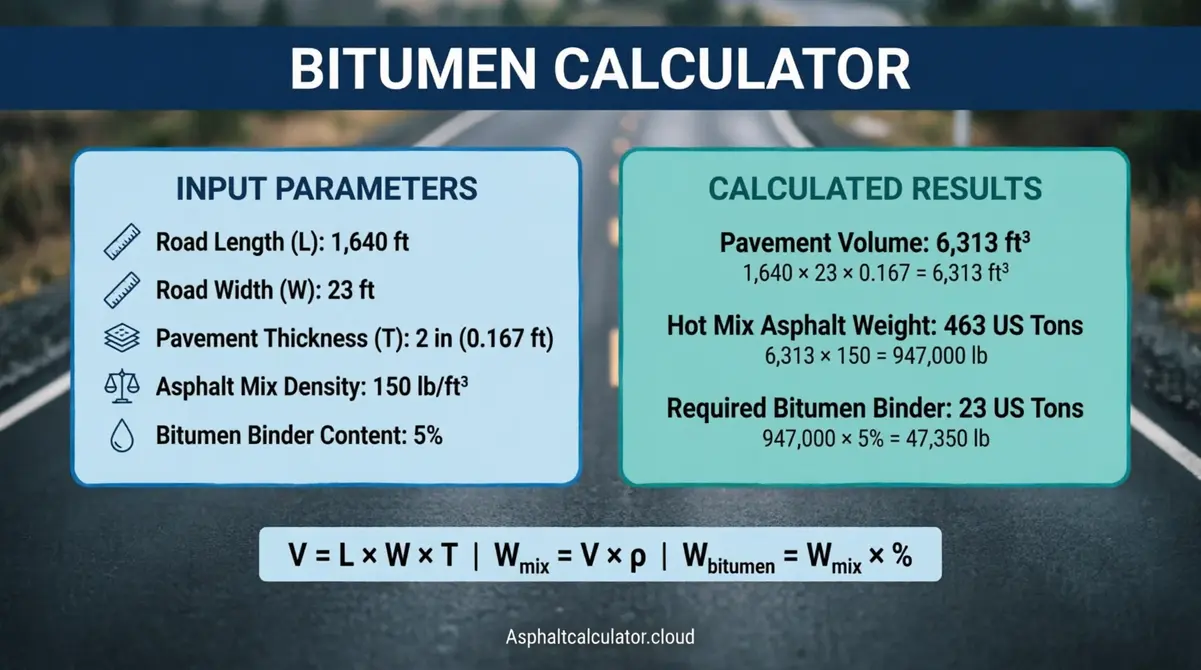
Calculating the required bitumen quantity for a 500-meter asphalt road section (Dense Bituminous Macadam layer) using the built-in bitumen calculator logic:
- Road length: 500 m (1,640 ft) | Road width: 7 m (23 ft)
- Compacted layer thickness: 50 mm (2 inches / 0.167 ft)
- Compacted asphalt density: 2400 kg/m³ (150 lb/ft³)
- Bitumen binder content: 5% by weight of the mix
Step-by-Step Road Bitumen Estimate
- Calculate pavement volume: 500 m × 7 m × 0.05 m = 175 m³ (6,313 ft³)
- Calculate total mix tonnage: 175 m³ × 2400 kg/m³ = 420,000 kg = 420 Metric Tons (463 US Tons)
- Calculate bitumen binder requirement: 420,000 kg × 5% = 21,000 kg = 21 Metric Tons (approx. 23.15 US Tons)
If purchasing bulk bitumen in standard 200 kg steel drums, 21,000 kg requires exactly 105 drums. If ordering road tankers with a standard 25 MT hauling capacity, this project requires one full tanker delivery with minimal remaining ullage.
Bitumen Density Calculator Guide: Temperature & Grading
Bitumen density is temperature-dependent. When using a bitumen calculator to evaluate bulk storage, calculating pure binder weight requires standard baseline density values. Paving bitumen exhibits high thermal expansion coefficients; its density decreases noticeably as temperature rises from ambient storage to hot application levels:
- Standard Reference Density: 1020 kg/m³ (1.02 g/cm³ or 63.7 lb/ft³) calibrated at standard room temperature of 15°C (59°F).
- Density Range by Grade: Paving grades (such as VG-10, VG-30, VG-40 or 60/70, 80/100 penetration) range from 1010 to 1050 kg/m³.
- Thermal Expansion Factor: As bitumen heats to 150°C–165°C for pumping and pugmill mixing, its working density drops to roughly 930–950 kg/m³. All purchasing invoices and refinery transfer weights are legally corrected back to 15°C using ASTM D4311 volume correction factors.
Bitumen Calculator Density vs. Temperature Reference Chart
| Temperature (°C / °F) | Effective Density (kg/m³) | Specific Gravity | Physical Operational State |
|---|---|---|---|
| 15°C (59°F) | 1020 kg/m³ | 1.020 | Solid / Semi-solid (Billing Baseline) |
| 25°C (77°F) | 1014 kg/m³ | 1.014 | Standard penetration testing temperature |
| 60°C (140°F) | 991 kg/m³ | 0.991 | Absolute viscosity test reference |
| 100°C (212°F) | 966 kg/m³ | 0.966 | Pumping temperature threshold |
| 135°C (275°F) | 945 kg/m³ | 0.945 | Kinematic viscosity test point |
| 160°C (320°F) | 930 kg/m³ | 0.930 | Hot plant asphalt pugmill mixing |
Bitumen Tank Volume Calculator for Storage Management
Bulk liquid bitumen is stored in heated horizontal or vertical cylindrical tanks on asphalt batching plants. To calculate liquid storage capacity within our bitumen calculator suite, engineers employ geometric volumetric equations paired with fluid height dipstick readings:
Vertical Bitumen Storage Tank Formula
Horizontal Cylindrical Tank Volume Formula
Example: A horizontal storage tank with 2.5 m diameter and 8 m length has a total internal volume of π × 1.25² × 8 ≈ 39.27 m³. At 15°C standard density (1.02 MT/m³), it holds approx. 40.05 Metric Tons of pure binder. However, when heated to 160°C (density ≈ 0.93 t/m³), the same physical volume holds approximately 36.52 Metric Tons of fluid binder.
Bitumen Blend Calculator: Mixing Penetration Grades
When an asphalt terminal or mixing plant needs to reach an intermediate binder grade (for example, blending hard 60/70 penetration bitumen with soft 80/100 bitumen), the blending module in our bitumen calculator follows a logarithmic mixing proportion:
For standard viscosity-graded (VG) binders, a linear proportion can approximate bulk target mixes:
Careful blending calculations prevent catastrophic binder softening or premature aging cracking, ensuring the final bitumen mix satisfies Marshall stability and Superpave performance grading criteria.
Bitumen Paint Calculator for Waterproofing & Damp-Proofing
Cold-applied bitumen paints and solutions provide damp-proofing on retaining walls, foundation footings, and gutters. Estimating coverage in the bitumen calculator follows these parameters:
- Coverage Rate: 1 Liter covers roughly 2.5 to 4.0 m² per coat (0.35–0.55 kg/m²).
- Recommended Coats: Minimum 2 coats for damp-proof protection on porous masonry.
- Formula: Liters Needed = [Surface Area (m²) ÷ Coverage per Liter] × Number of Coats.
On rough unrendered concrete blockwork, absorption increases by up to 25%. Always include a 10% allowance for rough textures, edge detail trim, and roller loss.
Bitumen Roof Sheet Calculator
Corrugated bitumen roofing sheets and modified bitumen (SBS/APP) torch-on membrane rolls require side and end overlap adjustments:
- Torch-on Membrane Rolls: Add 10% to 15% for side laps (typically 75mm to 100mm) and end laps (150mm).
- Corrugated Bitumen Sheets: Standard sheets measure 2.0 m × 0.95 m (1.9 m² gross area). Factoring 15%–20% overlap gives an effective coverage of about 1.55 to 1.60 m² per sheet.
Bitumen Spray Rate Calculation
Bitumen emulsions and cutbacks must be calibrated accurately to prevent bleeding or layer slippage. For residential surface dressing and chip seal cost estimation, check our tar and chip driveway cost calculator. The bitumen calculator supports typical bitumen consumption rates per square meter including:
- Prime coat bitumen calculation: 0.6–1.2 kg/m² applied directly over unbound granular base courses to seal sub-base capillary pores.
- Tack coat bitumen calculation: 0.2–0.5 kg/m² applied over existing asphalt to bond layers together.
- Chip seal / surface dressing: 1.2–2.0 kg/m² sprayed before stone aggregate distribution.
Common Jobsite Bitumen Calculation Mistakes
Errors in binder estimation can quickly lead to failed core samples or extensive contractor disputes. Keep the following technical points in mind:
- Confusing mix weight with aggregate weight: If a specification calls for 5% bitumen content, it means 5 kg of binder per 100 kg of total asphalt mix (aggregates + bitumen), not 5 kg added on top of 100 kg aggregate.
- Disregarding compaction loss: Loose hot mix asphalt spread by the paver screed is roughly 20% to 25% thicker than compacted pavement after static steel and pneumatic tire roller passes. Calculations must always use compacted thickness.
- Ignoring distributor spray truck spray bar widths: Spray rates on paper often deviate if spray nozzles on distributor bars are misaligned, causing streaking or localized bleeding.
Frequently Asked Questions About the Bitumen Calculator
Civil engineering standards use 1020 kg/m³ (1.02 g/cm³ or 63.7 lb/ft³) for pure bitumen binder at 15°C. Actual density ranges between 1010 and 1050 kg/m³ based on grade and temperature.
For spray coats: prime coats require 0.6 to 1.2 kg/m², tack coats need 0.2 to 0.5 kg/m², and chip seals require 1.2 to 2.0 kg/m². For hot mix pavement, bitumen mass depends on layer thickness and mix design percentage.
Multiply the volume in liters by the specific density (typically 1.02): Weight (kg) = Liters × 1.02. For example, 1,000 liters of bitumen equals 1,020 kg.
It calculates tank volume based on geometry: for cylindrical storage tanks, Volume = π × r² × length. Multiplying volume by hot bitumen density yields storage mass in tons.
Bitumen waterproofing paint covers between 2.0 to 4.0 m² per liter per coat, depending on surface porosity and application thickness.
A bitumen blend calculation uses the log-viscosity or penetration mixing rule: % Grade A × Value A + % Grade B × Value B = Target Grade Value, allowing asphalt plants to blend two penetration grades accurately.
Divide the total roof area by the net effective coverage per sheet (typically 1.55 m² to 1.60 m² after factoring end and side overlaps of 15% to 20%), then add 10% for cutting waste.
Bitumen percentage is calculated either by weight of the total asphalt mix or by weight of dry aggregate. By total mix: Bitumen % = (Weight of Bitumen / Total Weight of Asphalt Mix) × 100. By aggregate weight: Bitumen % = (Weight of Bitumen / Weight of Dry Aggregate) × 100. Standard road mix designs typically range between 4.5% and 6.0% binder content by total mix weight.
Related Paving & Asphalt Calculators
Plan and estimate your road paving, sub-base preparation, and surface treatment projects with our specialized civil calculation utilities:
This bitumen calculator provides engineering estimates for planning and estimation purposes based on typical industry mix designs and densities. Always verify exact bitumen grade (VG/Penetration), mix design specs, and jobsite compaction factors with a certified paving engineer.
Bitumen & Asphalt Calculator Tool - Bitu-Calc Pro
A preview of the Bitu-Calc Pro dashboard showing custom input parameters for length, width, thickness, and density along with accurate calculation results for total asphalt mix mass, surface area, and bitumen requirements.
Price Currency: USD
Operating System: Web Browser, Windows, macOS, Android, iOS
Application Category: BusinessApplication