Asphalt Density Calculator & Complete Paving Guide
Planning a driveway, highway segment, or parking lot project requires precision, and using an asphalt density calculator is the most reliable way to avoid under-ordering or project delays. Estimating materials accurately comes down to two main things: the physical area you are paving and the final compacted density of the mix. You can cross-reference batch orders with our dedicated asphalt tonnage calculator or evaluate multi-course roadway cross sections in the pavement calculator.
Enter core weights in grams according to ASTM D2726 to calculate Bulk Specific Gravity (Gmb) and field compaction percentage.
What is the Density of Asphalt and Why Does it Matter?
Before running your numbers through an asphalt density calculator, it helps to understand what density actually represents. Asphalt density is the mass of the mix per unit of volume once rollers have finished compacting it on site. Fresh asphalt directly from the plant is fluffy and holds substantial air voids; it only reaches structural strength and water resistance once compacted to its target density.
Imperial: 145 lb/ft³ (standard working range is 142 to 148 lb/ft³)
Metric: 2,320 kg/m³ (standard working range is 2,275 to 2,370 kg/m³)
| Mix Type | Density (Imperial) | Density (Metric) | Common Uses |
|---|---|---|---|
| Hot Mix Asphalt (HMA) | 145 lb/ft³ | 2,320 kg/m³ | Driveways, parking lots, main roads |
| Warm Mix Asphalt (WMA) | 143-146 lb/ft³ | 2,290-2,340 kg/m³ | Low-temp paving, longer hauls |
| Recycled Asphalt (RAP) | 135 lb/ft³ | 2,160 kg/m³ | Base courses, farm tracks, sub-layers |
| Cold Lay / Cold Patch | 105-110 lb/ft³ | 1,680-1,760 kg/m³ | Emergency pothole repairs |
| Porous Asphalt | 120-130 lb/ft³ | 1,920-2,080 kg/m³ | Permeable parking bays, drainage tracks |
Asphalt Density Formula Used in Every Asphalt Density Calculator
Every dependable asphalt density calculator uses the fundamental relationship between volume and mass:
Weight = Volume × Density
Step 1: Find Layer Volume
Convert layer thickness to match your length and width measurements:
Imperial: Volume (ft³) = Length (ft) × Width (ft) × (Thickness (inches) / 12)
Metric: Volume (m³) = Length (m) × Width (m) × Thickness (m)
Step 2: Convert to Total Tonnage
US Tons: US Tons = (Volume (ft³) × 145) / 2,000
Metric Tonnes: Metric Tonnes = (Volume (m³) × 2,320) / 1,000
Practical Examples: Manual vs Asphalt Density Calculator Results
You can verify the math behind an online asphalt density calculator with these simple walk-throughs.
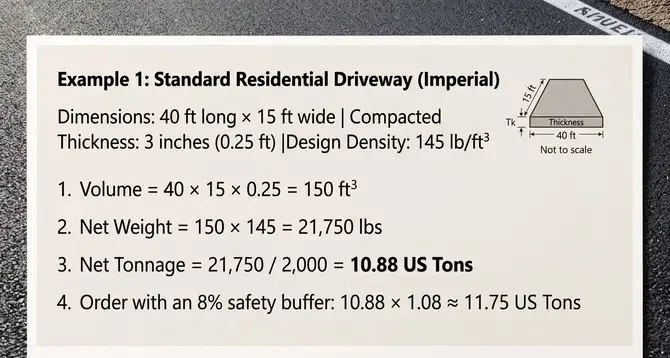
Area: 40 ft long × 15 ft wide | Compacted Thickness: 3 inches (0.25 ft) | Target Density: 145 lb/ft³
- Volume = 40 × 15 × 0.25 = 150 ft³
- Weight (lbs) = 150 × 145 = 21,750 lbs
- Tons Needed = 21,750 / 2,000 = 10.88 US Tons
- Order with 8% buffer: 10.88 × 1.08 ≈ 11.75 US Tons
Area: 20 m long × 6 m wide | Compacted Thickness: 50 mm (0.05 m) | Target Density: 2,320 kg/m³
- Volume = 20 × 6 × 0.05 = 6.0 m³
- Mass (kg) = 6.0 × 2,320 = 13,920 kg
- Tonnes Needed = 13,920 / 1,000 = 13.92 Tonnes
- Order with 8% buffer: 13.92 × 1.08 ≈ 15.03 Tonnes
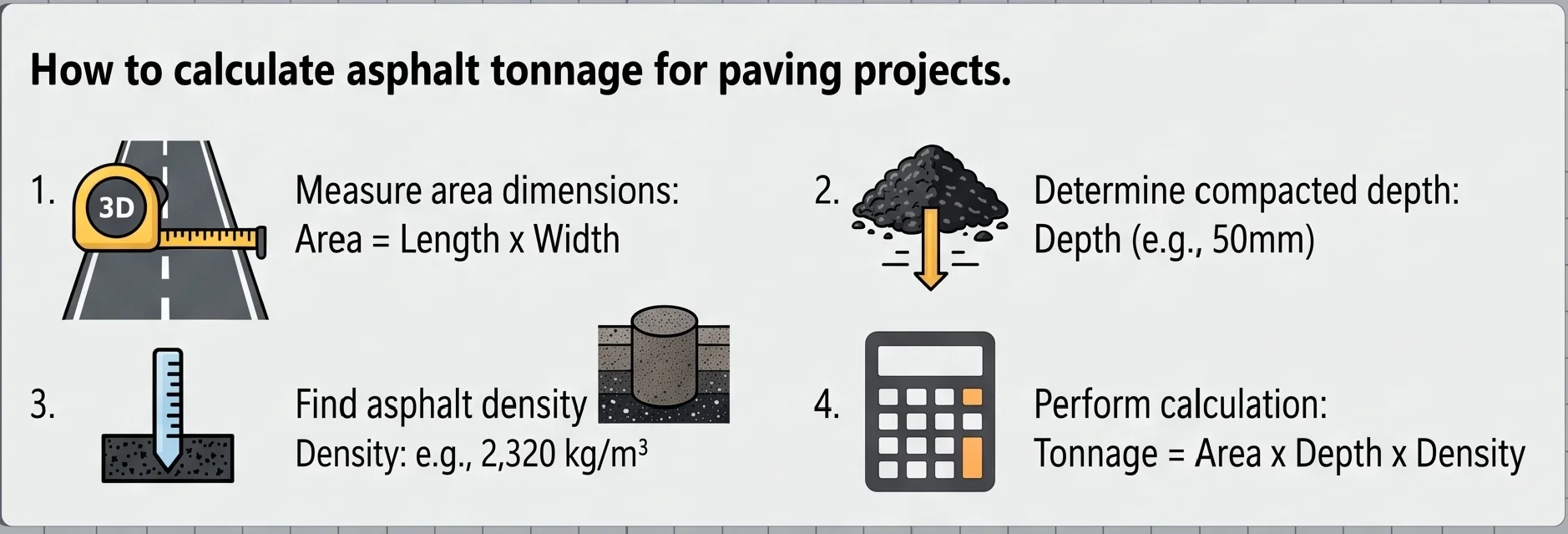
How to Calculate Asphalt Tonnage for Paving Projects
Calculating asphalt quantities requires combining your paving footprint with the compacted unit weight of the mix design:
- Measure area dimensions: Determine your project footprint by calculating total area (Area = Length × Width).
- Determine compacted depth: Specify the finished, rolled thickness required for the pavement course (e.g., 50 mm or 2 to 3 inches).
- Find asphalt density: Identify the target mix density from your batch design, typically 145 lb/ft³ (Imperial) or 2,320 kg/m³ (Metric).
- Perform calculation: Multiply surface area by thickness and density (Tonnage = Area × Depth × Density), then divide by 2,000 lbs (US tons) or 1,000 kg (metric tonnes). Always add an 8% to 10% buffer for waste and subbase compaction.
How to Use an Asphalt Density Calculator for Paving Projects
Operating an asphalt density calculator requires three simple project figures:
- Enter Surface Dimensions: Input length and width (or total surface area) in feet or meters.
- Specify Compacted Depth: Enter desired finished thickness in inches or millimeters.
- Choose Mix Density: Select your mix type (default is 145 lb/ft³ or 2,320 kg/m³).
- Account for Compaction & Waste: Add an 8% to 10% safety buffer to protect against thin spots and material loss.
Asphalt Core Density Calculation for Field Quality Control
Estimating total tonnage is only the first step. Engineering teams also perform an asphalt core density calculation to verify field compaction quality. Cylindrical core samples are drilled on-site and weighed according to ASTM D2726 testing protocols (water displacement test).
1. Bulk Specific Gravity (Gmb)
Gmb = A / (B – C)
- A = Dry core weight in air
- B = Saturated surface-dry (SSD) weight in air
- C = Core weight submerged in water
2. Field Density Conversion
Core Density (lb/ft³) = Gmb × 62.4
Core Density (kg/m³) = Gmb × 1,000
3. Compaction Level Target
% Compaction = (Gmb / Gmm) × 100
Where Gmm is the mix’s maximum theoretical density (Rice gravity). Acceptable road specifications demand field compaction between 92% and 97%. Falling below 92% allows water penetration, while exceeding 97% forces bitumen to bleed onto the surface. For liquid binder quantities, consult our companion bitumen calculator.
Coverage Rates and Ordering Rules
Standard Hot Mix Asphalt at 145 lb/ft³ provides dependable coverage benchmarks:
| Imperial Thickness | Coverage (per 1 US Ton) | Metric Thickness | Coverage (per 1 Tonne) |
|---|---|---|---|
| 1″ thick | ≈ 160 sq ft | 25 mm thick | ≈ 14-18 m² |
| 2″ thick | ≈ 80 sq ft | 50 mm thick | ≈ 7-9 m² |
| 3″ thick | ≈ 54 sq ft | 75 mm thick | ≈ 5-6 m² |
| 4″ thick | ≈ 40 sq ft | 100 mm thick | ≈ 3.5-4.5 m² |
Why Add a 5% to 10% Contingency Buffer?
Loose asphalt from the plant compresses down by roughly 20% to 25% under heavy steel drum rollers. In addition, gravel base layers are never perfectly smooth, and edge trimming naturally produces scrap. Adding an 8% to 10% buffer ensures work never stalls mid-pour.
Explore Our Complete Paving Tools
Frequently Asked Questions (FAQs)
What default weight does an asphalt density calculator use?
A standard asphalt density calculator uses 145 lb/ft³ (2,320 kg/m³) for hot mix asphalt, as this reflects properly compacted finished pavement.
How do you perform an asphalt core density calculation?
Measure the core dry weight (A), saturated surface-dry weight (B), and submerged weight (C). Compute Gmb = A / (B – C), then multiply Gmb by 62.4 lb/ft³ (or 1,000 kg/m³).
How much area does 1 ton of asphalt cover?
At 2 inches compacted thickness, 1 US ton covers about 80 square feet. At 3 inches, it covers approximately 54 square feet.
Why do you need an asphalt density calculator instead of estimating by eye?
Loose asphalt compresses 20% to 25% when rolled. An asphalt density calculator removes guesswork by combining compacted density with surface dimensions so you order the exact tonnage required.
What is an acceptable compaction percentage?
Field compaction should stay between 92% and 97% of the theoretical maximum specific gravity (Gmm).
How many cubic yards are in 1 ton of asphalt?
One US ton of compacted asphalt equals roughly 13.8 cubic feet or 0.51 cubic yards. One full cubic yard weighs about 1.96 US tons (3,915 lbs).
Asphalt Density Calculator: Tonnage, Coverage & QC Testing
Free asphalt density calculator to estimate paving tonnage, square feet coverage, core density (Gmb), and cubic yard conversion with custom waste buffers.
Price Currency: USD
Operating System: All
Application Category: Business Application